
Another Year of Reading
Opinions and Confessions
In May, when I began a fresh notebook (no. 24, if you’re curious), I wrote, “Whatever I write here, I will see whenever I flip back. It can seem naïve or pessimistic, hopeful or cynical.” Over the years I’ve learned not to hope, or at least I think I’ve learned — only to get caught hoping when it’ll hurt the most.
The Vulnerable Part
Some years are larger than others. In 2024, I published a novel and did the usual writer-with-a-new-novel things. I even earned out for the first time, and had a profile in the LA Times. But in 2025, I blew up my life altogether.
After living in one place for twelve-and-a-half years, we sold our house and most of our furniture, put fifty-five boxes of books in storage, gave away thirty-some plants, and got on a plane to Paris. My novel came out in paperback and, somehow, I signed copies at Smith & Son and Shakespeare and Company. I saw Cézannes at the d’Orsay. We went to Dijon, Lyon, Les Causses, Toulouse, Villefranche-sur-Mer, Nice, and finally Marseille. I read Françoise Sagan’s Bonjour Tristesse on a nude beach near Eze and road a fucking bicycle through a vineyard in the Bourgogne. I took Ripley Underwater to San Remo, Italy — the town where Dickie Greenleaf takes his last boat ride. I finished William Maxwell’s The Château at an actual château, dropped in a canyon in the mountains of southern France. In Marseille, when I wasn’t sneaking out for €2 Pastis, I hid in an apartment across the street from Saint Charles, where I began rewriting a novel that’d been torturing me for years.
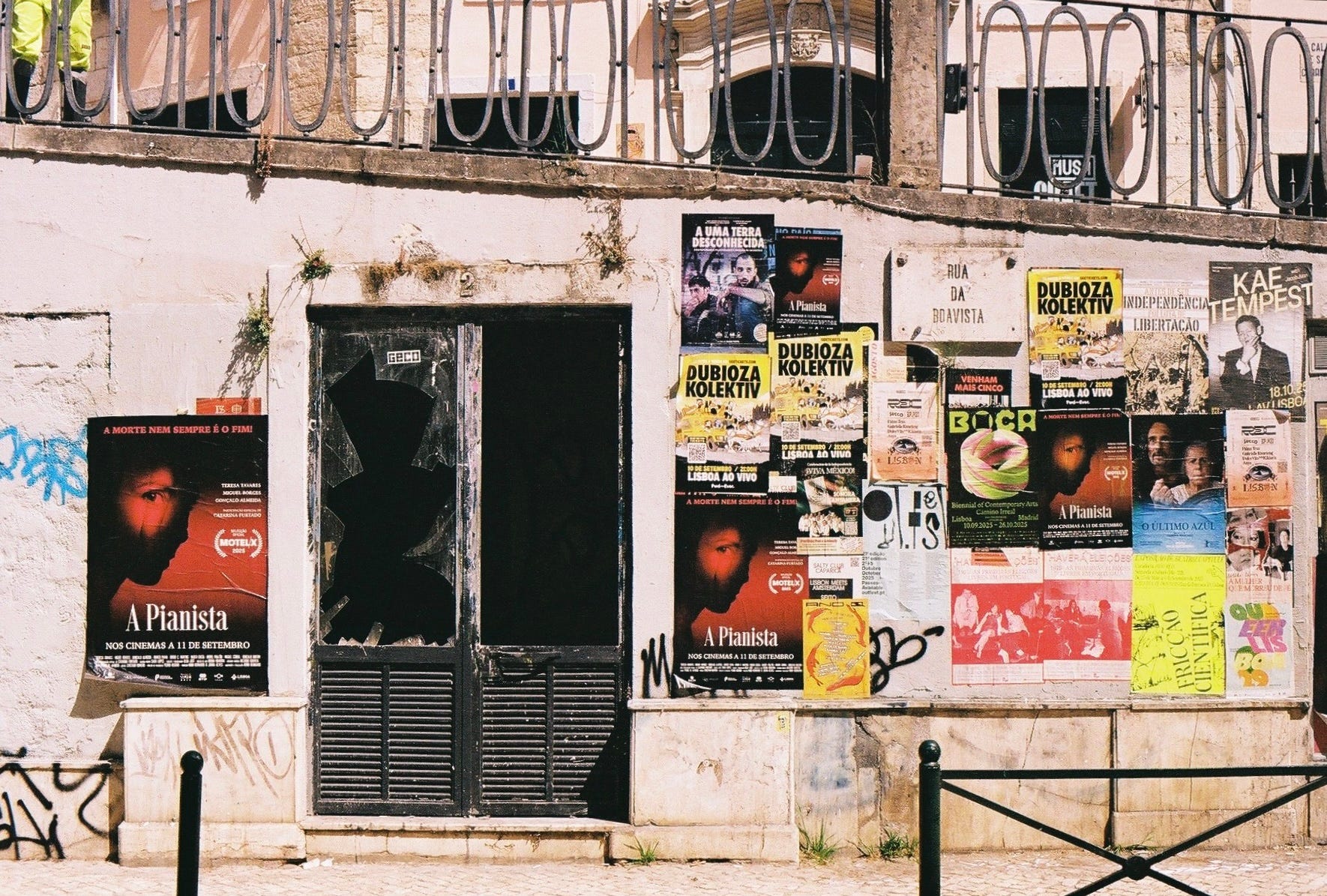
After six weeks in France, we got on a plane and went to Lisbon, where we had an apartment lined up for a visa we were still waiting for, and began living — or a kind of living. We joined a gym. We went grocery shopping. I wrote a handful of essays. We strolled through parks. We slunk through the bureaucratic maze of applying for a Navegante card, which allows you to get anywhere in the metro for only €40/month. We met some neighbors and joined them for drinks. A close friend invited me to Venice for her fiftieth birthday, so we went to Venice. We went to Venice. We visited the Peggy Guggenheim collection, which is second only to MoMA in its riches of American painters. We saw Titians and Tintorettos. I visited a monastery, all by itself on some island, and saw Lord Byron’s bedroom.
But back in Lisbon, the visa never came. We ran out of time. We packed up our things and got on a plane and returned to the United States, where I was so desperate for smalltalk I chatted with TSA agents and bartenders at Newark airport.
Thankfully, I had a writing residency lined up — generously offered to me early in the year — and ended up at the Sitka Center for Art and Ecology, on the Oregon coast. I essentially lived here, since I had nowhere else to live, and in two weeks I finished rewriting that cursed novel after thirteen years of carrying it around like a block of lead. When it was over, I returned to Minnesota.
Now I’m living in a family member’s basement, an hour outside of the city I thought I’d left. I sold my home and left a terrible situation to try to remember who I was, what I cared about; but, after all those months of living in a fantasy, hemorrhaging money and thinking it would get me somewhere, I feel mutilated. I still get emails from people who congratulate me on my move to Paris or to Lisbon or the south of France, wherever they imagine I am; and meanwhile, on our way to the gym, I read the bible verses the local Chevy dealership off Highway 10 shares on its billboard in between sales offers. Nothing prepares you for this kind of whiplash. Everything after this moment is blank.1

The Literary Part
Books, though — for when you can’t look at paintings or sit in real restaurants. It was another year of rereading, starting with a return to the second volume of Sontag’s journals (which I wrote a little about here). I picked up Denis Johnson’s Largesse of the Sea Maiden for the third or fourth time — and was astonished for the third or fourth time. I did my annual reread of The Waste Land, which I wrote about in April; and to note its hundredth anniversary I talked about my reread of The Great Gatsby with Danny Maloney. I reread Nabokov’s absolutely insane novel, Ada, or Ardor, for the first time in nearly twenty years; it might be part of what gave me permission to finish the ridiculous novel I was working on, since the ideal (and maybe only) reader for Ada is clearly Vladimir Nabokov. When Martin Amis died, I cracked open The War Against Cliché, which is maybe the best book of literary criticism ever put together (and which I wrote about here). While I made coffee every morning, I reread all of Shakespeare’s sonnets, and while puffing on Gauloises at a French dive I reread Philip Larkin’s Collected Poems and Anne Carson’s Glass, Irony & God. On my return to the United States, I returned to Wilde’s De Profundis, which I hadn’t revisited since my own trip through the abyss two decades ago.
I continued on my DeLillo adventure (I was embarrassingly late to the greatest living American novelist) with his debut, Americana, which — like Louise Erdrich’s Love Medicine — made me feel like there should be another word for when a legit genius publishes a first novel. As though preparing myself for other cities, I read Lesley Chamberlain’s Nietzsche in Turin and Enrique Vila-Matas’ Never Any End to Paris. I read James Purdy’s Narrow Rooms, which, along with the Basilica in Lyon, outed me as an agnostic catholic. Thanks to Sam Glatt, I read Tezer Özlü’s Cold Nights of Childhood and Journey to the Edge of Life; the latter was one of my favorites of the year. I read all of Denis Johnson’s poetry, which is surprisingly hit and miss, as well as all of George Oppen and Wisława Szymborska. I spent time in Diane Arbus’s hideous mind with Arthur Lubow’s wonderful biography, as well as Elizabeth Hardwick’s wonderful mind with Cathy Curtis’s just-okay A Splendid Intelligence. Speaking of intelligence, I finally got around to Richard Hofstadter’s Anti-Intellectualism in American Life, which was stunning, as well as Alfred Kazin’s On Native Grounds. It turns out I’m a sucker for intellectual history. After it sat around for a decade and a half on my shelves, I finally picked up Nabokov’s Lectures on Literature, and about fell over when he makes the claim that Emma dies because she’s a bad reader. In a bathtub, I luxuriated in Edmund White’s The Beautiful Room is Empty, and have photos to prove it. Don’t ask.
For the first time, I read Fitzgerald’s The Beautiful and Damned, which is about a hundred pages too long and definitely a minor work. I exhausted myself with Thomas McGuane’s The Bushwhacked Piano, which should’ve received a coauthor credit from Cocaine. As much as I love Joy Williams, my encounter — at long last — with The Changeling was a disappointing one; it’s just long enough to run out of dazzle, and beyond the dazzle and the alien there isn’t much. In Venice, I picked up Hemingway’s Across the River and Into the Trees, which I began reading on my way back from Oregon, and all I’ll say is that there’s bad, self-parodic Hemingway (For Whom the Bell Tolls, The Old Man and the Sea) and then there’s atrocious, can’t-write-his-way-out-of-a-tumbler Hemingway. Later, I picked up Saul D. Alinksy’s Rules for Radicals, which has an astounding, almost clairvoyant prologue, followed by a hundred-and-some pages of nonsense.
On the plane to Paris (and in several other places) I tried Madame Bovary en français but it was far beyond my abilities, so I gave it up for Sagan (see above). On a rocky beach near Niolon, an hour outside Marseille, I read Gertrude Stein’s Paris France, and it’s impossible to imagine A Movable Feast even existing without it. At a terrace table across from the Basilique Saint-Sernin in Toulouse, I read Sue Roe’s In Montparnasse, a tepid but enjoyable history of early surrealism. Between the Lisbon metro and a handful of beaches, I read Adam Zagajewski’s Slight Exaggerations, Zena Hitz’s Lost in Thought, and, one of my favorites of the year, Philip Glass’s Words Without Music — a name– and jaw-dropping memoir I’m surprised more people don’t include on those “New York was so great” reading lists we always see. I was also working through my first book in Portuguese — a collection of essays about the Portuguese temperament by José Gil — but only made it about thirty or forty pages before our clock ran out, and aside from a few emails I haven’t read or written in Portuguese since. Back home, I finally finished The Mill on the Floss, which I’d picked up in the little bookstore literally around the corner from our apartment off the Avenida Mârques de Tomar. And most recently, in preparation for a surprise project, I finished Jerry Rosco’s Glenway Wescott Personally.
Not including some wonderful manuscripts (a record year! thank you, clients <3), I also read a fair amount of new and newish books, including some new translations or reissues:
Katie Kitamura, Audition
Ever since Gone to the Forest, which I picked up on a Teju Cole recommendation, I’ve relished the spookiness in Kitamura’s singular novels. While not my favorite, Audition is maybe her most uncanny and uncomfortable, pushing the form itself to debatable limits.
Ada Calhoun, Crush
In this romp, a husband accidentally ruins his marriage by telling his wife how hot it would be if she kissed another man. Throughout, I kept thinking this is what a Jane Austen novel would be if she’d read Benjamin and Barthes — and it turns out to be a true delight.
Hal Ebbot, Among Friends
In this little-discussed debut, two childhood friends bring their families together for a long weekend, leading to a terrible betrayal that they waspishly refuse to acknowledge. It’s beautifully written, but impossible to imagine without James Salter, and its refusal to pinpoint any version of technology (we have the vague “car,” and “phone”; there are newspapers, of course, and airplanes) makes the setting almost disingenuously “anytime,” even though the aforementioned betrayal has very different connotations depending on the decade. Throughout, I kept wondering if you could really get away with writing what amounts to midcentury drag, and I’m still not sure I’ve answered myself.
Ayşegül Savaş, The Anthropologists
A couple that can no longer get away with calling themselves young must decide whether to settle (a.k.a. purchase an apartment) in their unnamed adoptive city that is certainly Paris. I don’t know how she does it, but Savaş takes this simple tale and turns it into a magnetic portrait of loneliness abroad and the nature of home.
Matteo Bianchi, The Life of Those Left Behind (trans. Michael F. Moore)
It was fine.
Isa Arsén, The Unbecoming of Margaret Wolf
Another undersung sophomore novel that deserves a lot more love, Arsén’s beautiful, Fitzgeraldian novel about talent, independence, and friendship is marvelously written and often very funny.
Andrew Porter, The Imagined Life
As a kind of unsolvable anti-mystery, openly taking its obscurant cues from Antonioni’s L’Avventura, Porter’s novel is a solid portrait of a grieving mind, though I don’t really buy all the Fleetwood Mac stuff, no matter how much I love Fleetwood Mac. But in its treatment of a friendship between two middle-school boys, it’s a kind of contemporary Separate Peace, and one of the tenderest novels I’ve read in years.
David Wojnarowicz, Memories that Smell Like Gasoline
In a beautiful rerelease from Nightboat Books, Gasoline is another invigorating line of Wojnarowicz’s impeccable style and intensity for anyone in need of a new bump, but it deserved a much more thoughtful and relevant foreword.
Solvej Balle, On the Calculation of Volume, Book 1 (trans. Barbara J. Haveland)
Balle’s take on the time loop is at least a little fresh, and I mostly enjoyed reading it, but once it was over I saw absolutely no reason to continue with subsequent volumes.
Wassily Kandinsky, Concerning the Spiritual in Art (trans. Ruth Ahmedzai Kemp)
Sometimes you can only admire the fierce and confident beliefs of early twentieth century artists, despite their naïveté and error. Still, Kandinsky excels at reminding artists just what’s at stake in what they create, and what they owe a polysemic version of human consciousness fragmented by Modernism.
Mathias Énard, The Deserters (trans. Charlotte Mandell)
A minor and forgettable novel from one of the world’s greatest writers of fiction.
Elias Canetti, The Book Against Death (trans. Peter Filkins)
You can only read the word “death” so many times before it starts to sound like a guy lying around in a gutter asking for change, but as with any experience with Canetti the fragments of brilliance are nonetheless worth it.
Erin Somers, The Ten Year Affair
A novel so good I had to write about it at length, Somers takes one of the most banal fantasies not only in literature, but in all of humankind, and reinvents it. As a bonus, it’s also one of the funniest books I’ve read in years.
Sally Mann, Art Work
Despite the “hoist up your trousers and get to work” attitude, Mann’s memoir is an enjoyable “how I did it” about her artistic career, with one insane chapter in the middle involving a trailer and the most horrific tenants I’ve ever encountered in a book. If you’re looking for a way to procrastinate and underline stuff like “Work hard,” a great read.
That’s it. Thank you for reading. I wish you all luck, safety, and happiness in the new year.
I’m trying to keep busy with freelance assignments and copy work. Finding a place to live has turned into yet another activity where software (“I’m Lisa, your AI leasing agent!”) tries to solve your problems, only to create more. We’re just far enough away that we haven’t really seen any friends since we got back. I genuinely don’t know what to do, or even what to want. But there’s nothing to do but try.
Reading this in Lisbon adds a tinge of sadness to the end of the year. You and I could have been neighbors! As always, reading you is my favorite part of the day.
Some great reflections here Patrick; glad to read that despite it all, you’re doing well